
Visual essay
Why individual researchers still lack access to knowledge
A 16-slide visual essay on what disappears when institutional access ends—and what a better system could look like.
For years, the process was so ordinary that I barely noticed it.
I would encounter an unfamiliar term in a paper, follow it into another paper, open a technical standard, consult a book and return to the original question with a better understanding of what I did not know. Some sources were useful. Others were dead ends. The important thing was that the trail remained open.
Then I graduated, and the trail broke.
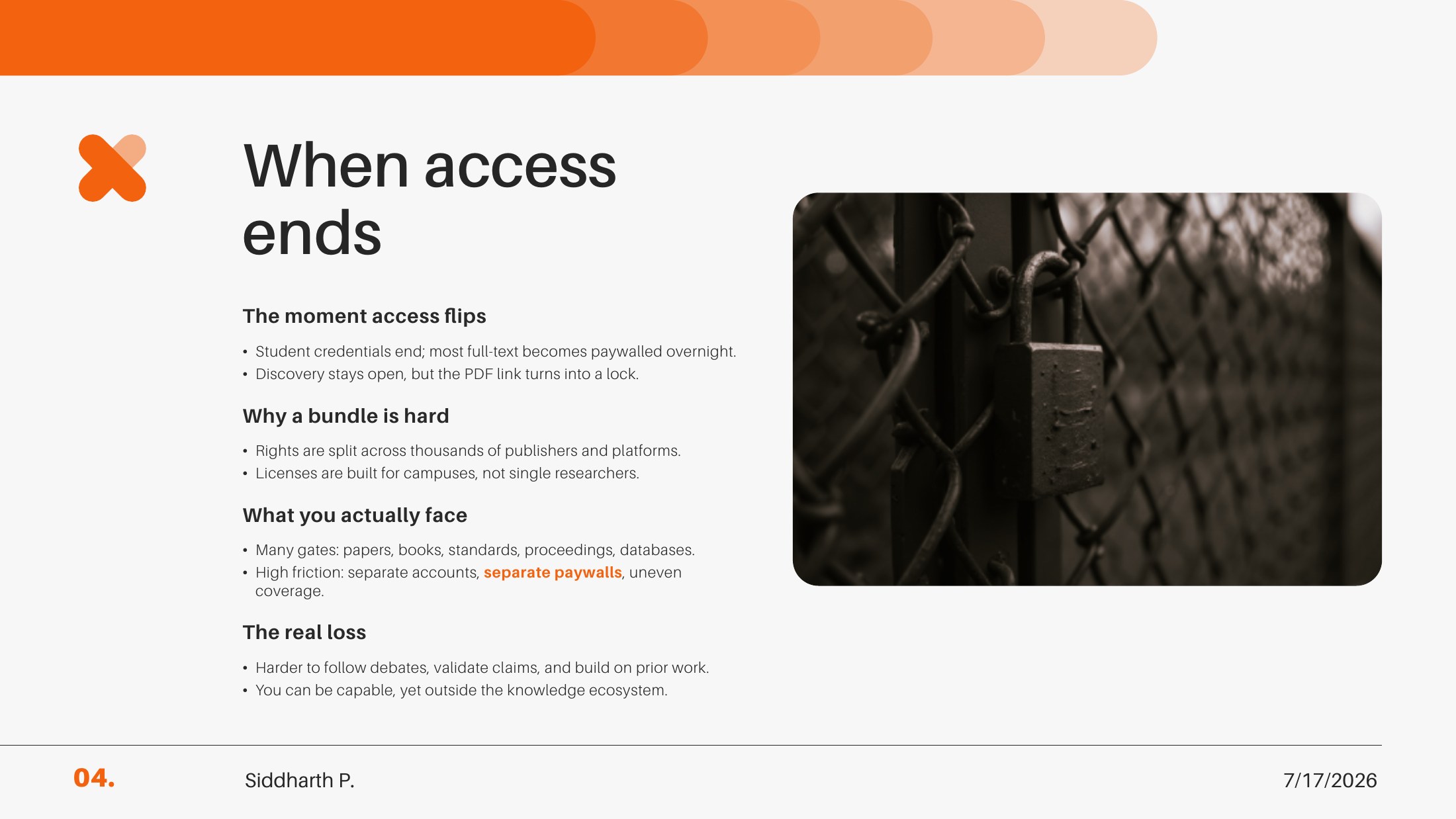
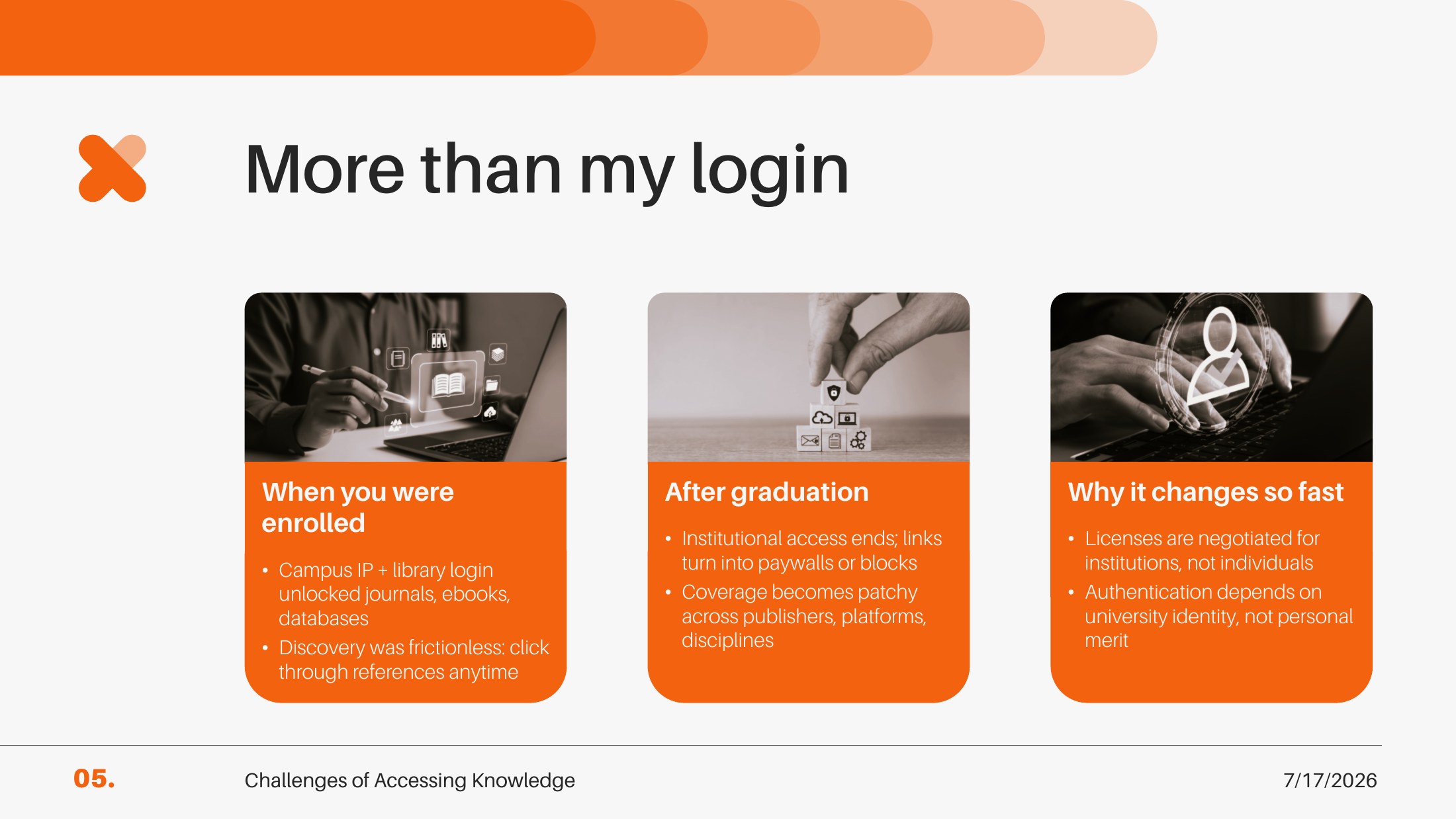
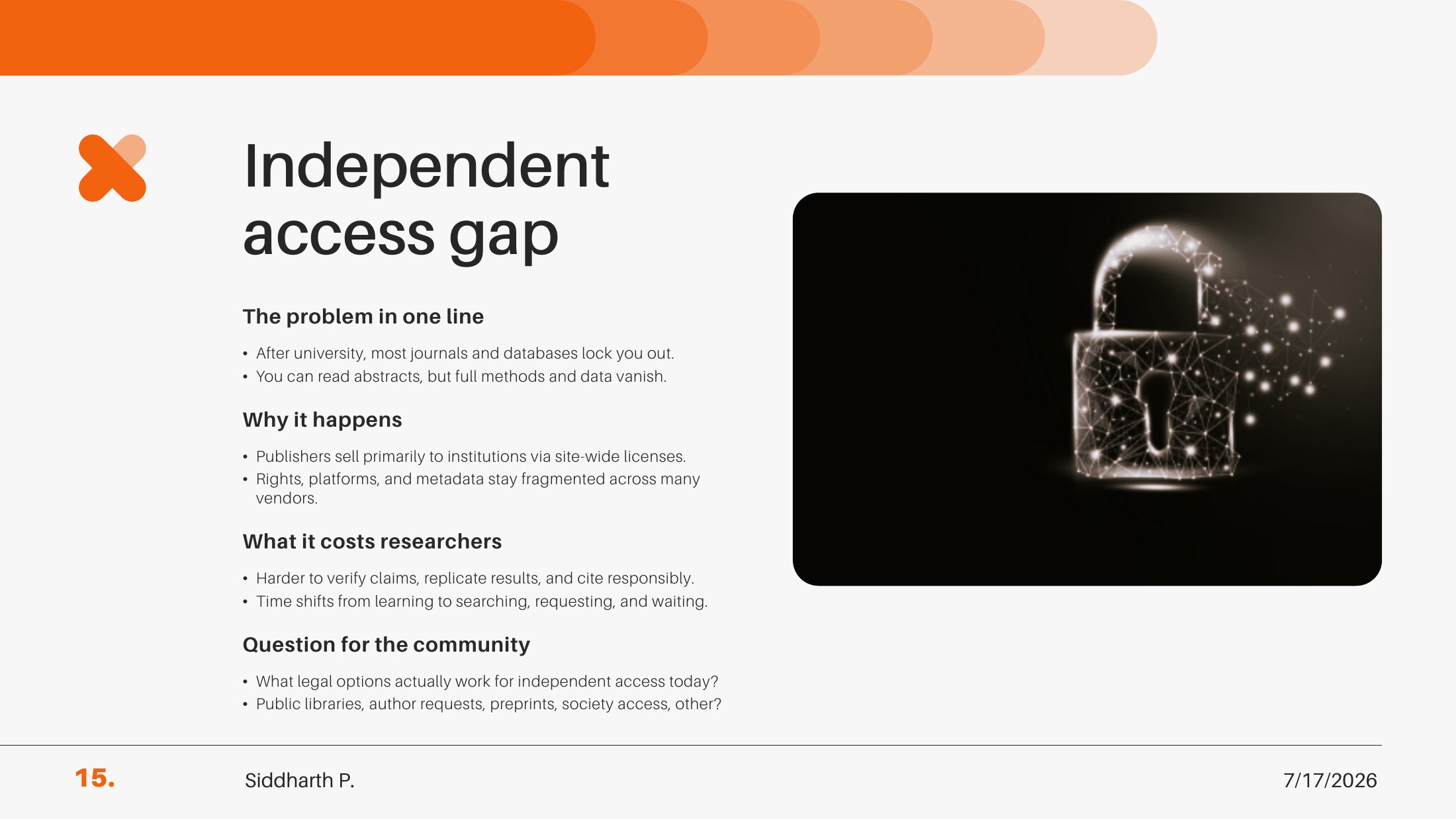
My institutional login stopped working. Journals that had opened with one click began asking for payment. Databases disappeared behind authentication screens. Technical standards became individual purchases. Books that had seemed digitally present everywhere turned out to be available only because a university library had negotiated access on my behalf.
Nothing about my need for knowledge had changed. Only my institutional status had.
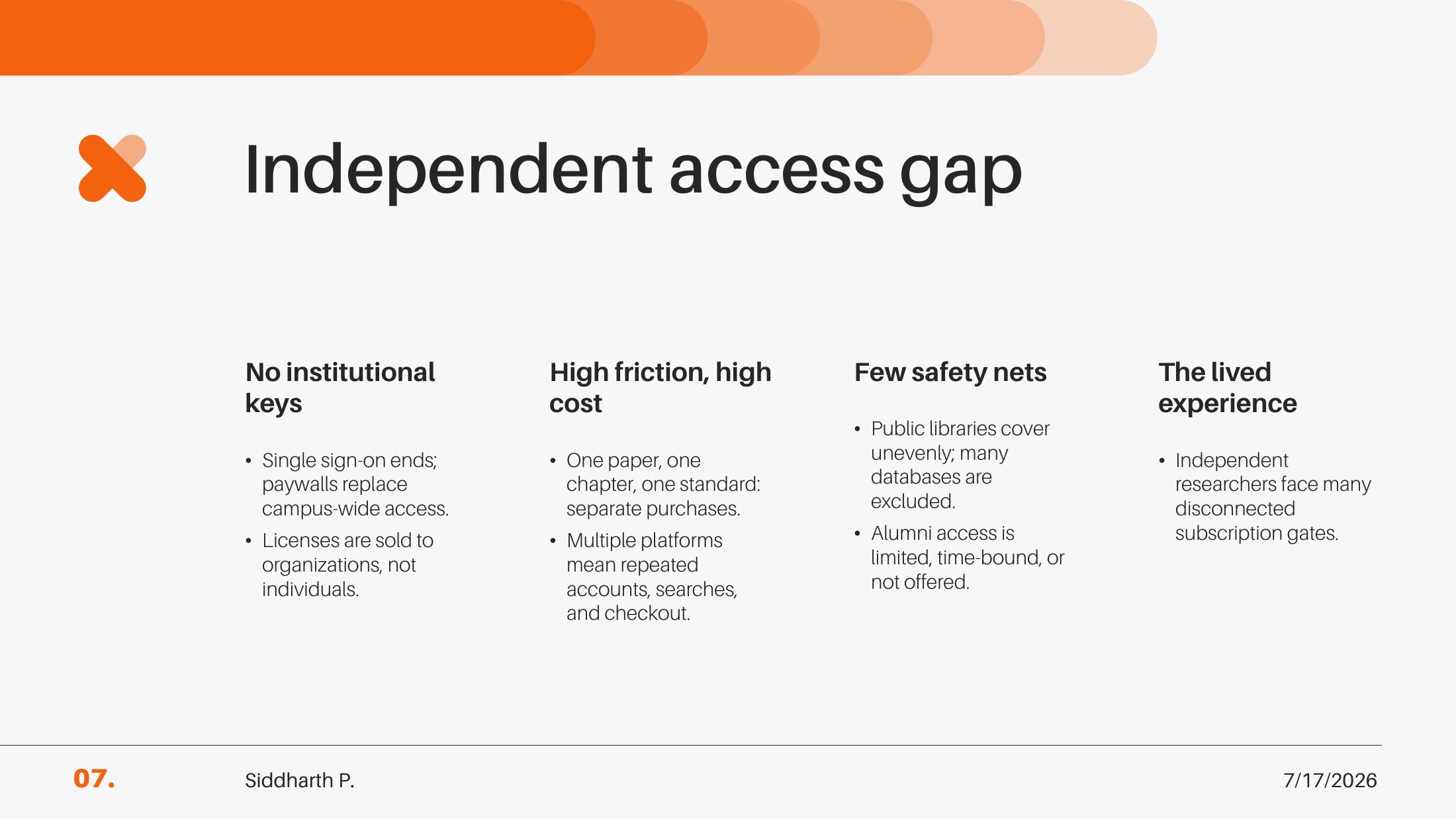
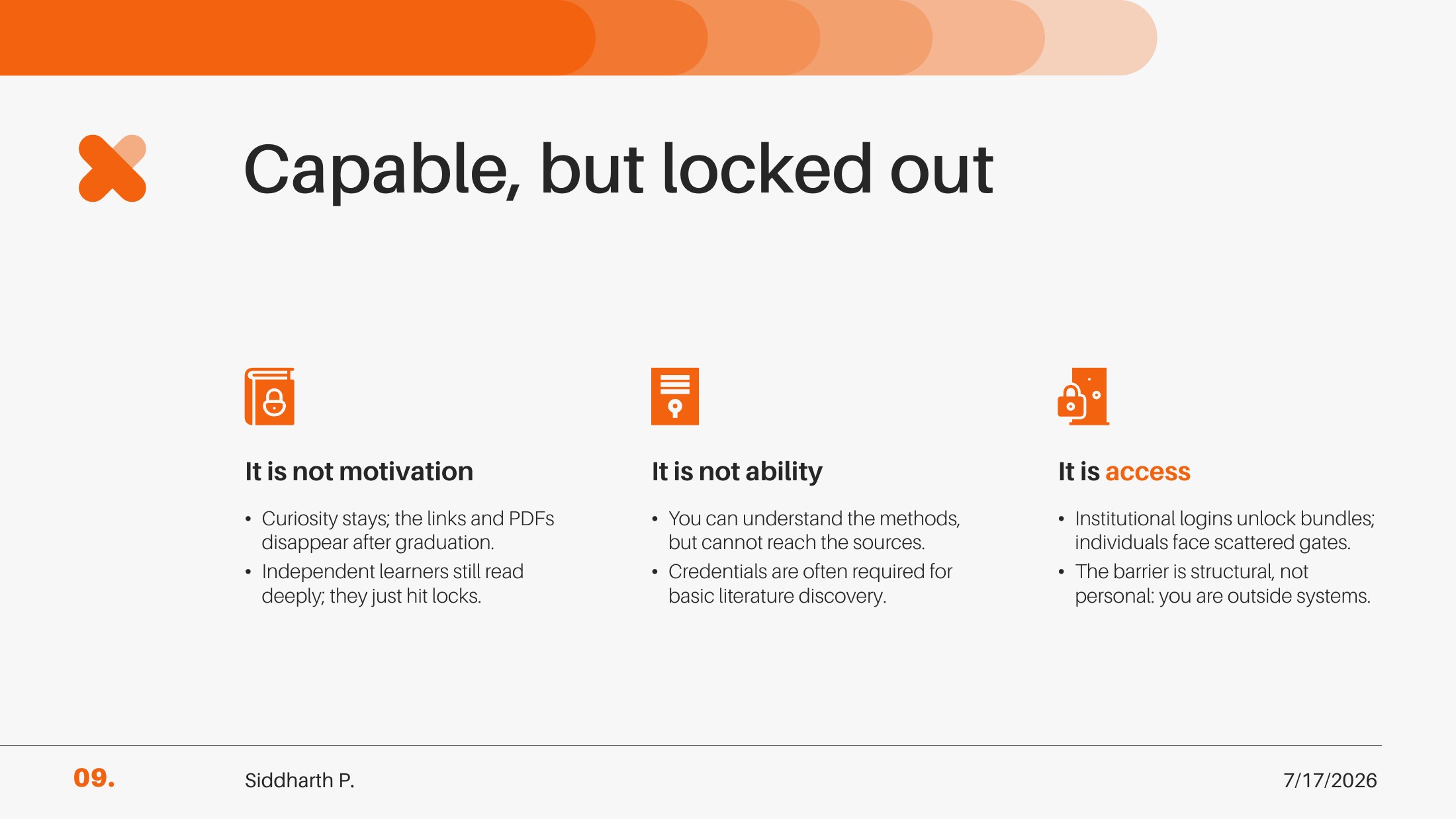
That small administrative change exposed a much larger problem: serious knowledge is often made accessible not to people, but to affiliations.
A university login can disappear overnight; the need to research does not.
The invisible library card
University access feels seamless because the complexity has been hidden.
Behind a campus login sits a patchwork of contracts covering journal publishers, ebook platforms, citation indexes, specialist databases and standards collections. The institution pays, negotiates terms, manages authentication and helps users navigate the result. The student sees a search box and a PDF button.
Leaving the institution removes that invisible infrastructure all at once.
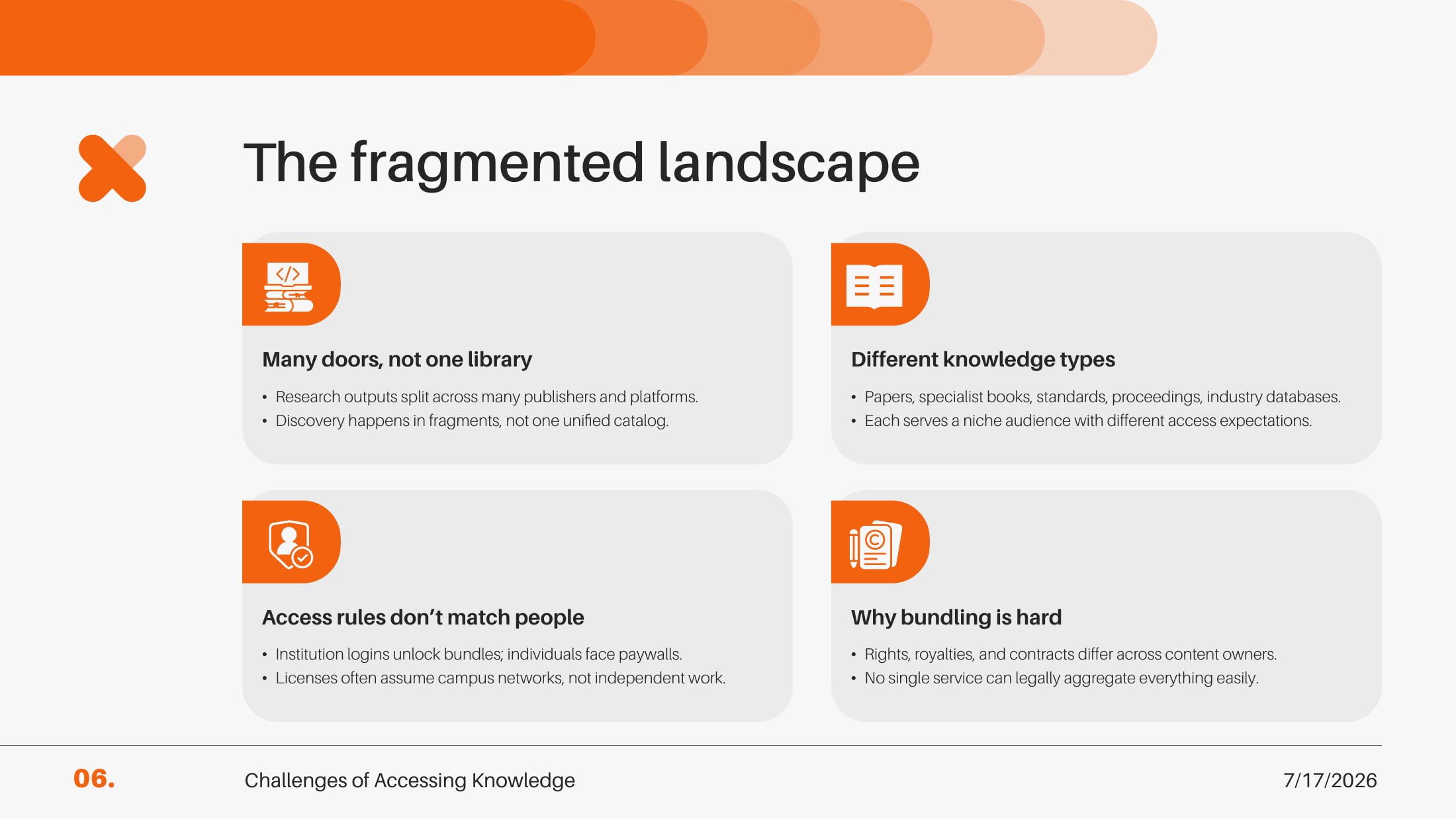
The effect is easy to mistake for a simple paywall problem. It is broader than that. Research papers may be distributed across publisher sites, subject repositories, institutional archives and preprint servers. Books follow different licensing arrangements. Industry databases have their own commercial models. Technical standards are usually controlled by standards organizations and national members. Each source has its own search interface, access rules and price.
The independent researcher is not facing one locked library. The researcher is facing hundreds of doors, each with a different key.
Independent does not mean amateur
The access model still assumes a familiar division: serious research happens inside universities and large organizations; everyone else is part of the general public.
But professional life is not organized so neatly.
Engineers leave employers and continue studying. Consultants investigate unfamiliar industries. Designers need material evidence. Small businesses assess regulations and technologies. Researchers work between appointments. People develop ideas before they have a grant, a laboratory or an institutional email address. Graduates remain intellectually active even when their formal affiliation has ended.
In many of these roles, access to evidence is not an academic luxury. It is part of acting responsibly.
A professional may be expected to understand current research, identify the applicable standard, verify a technical claim and distinguish established knowledge from marketing. Yet the sources required to do that may be priced and licensed for institutions rather than individuals.
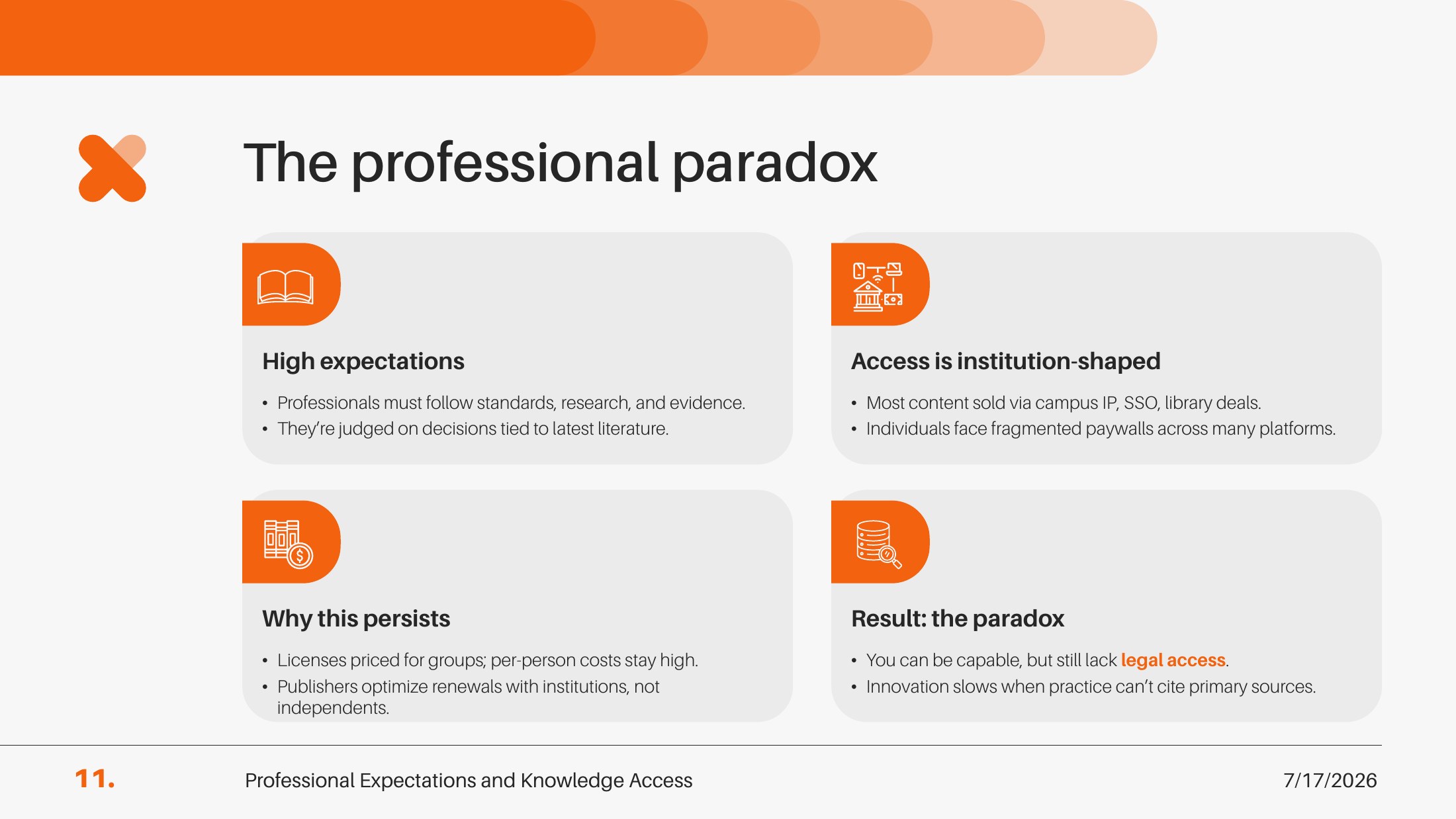
The result is a professional paradox: people are asked to remain evidence-led while the infrastructure of evidence remains institution-led.
Professionals are expected to work from evidence while the strongest access remains tied to institutions.
Why there is no Netflix for knowledge
The comparison with entertainment subscriptions is tempting. A modest monthly payment can provide an enormous catalogue of music or film. Why not create the same thing for research papers, specialist books and technical standards?
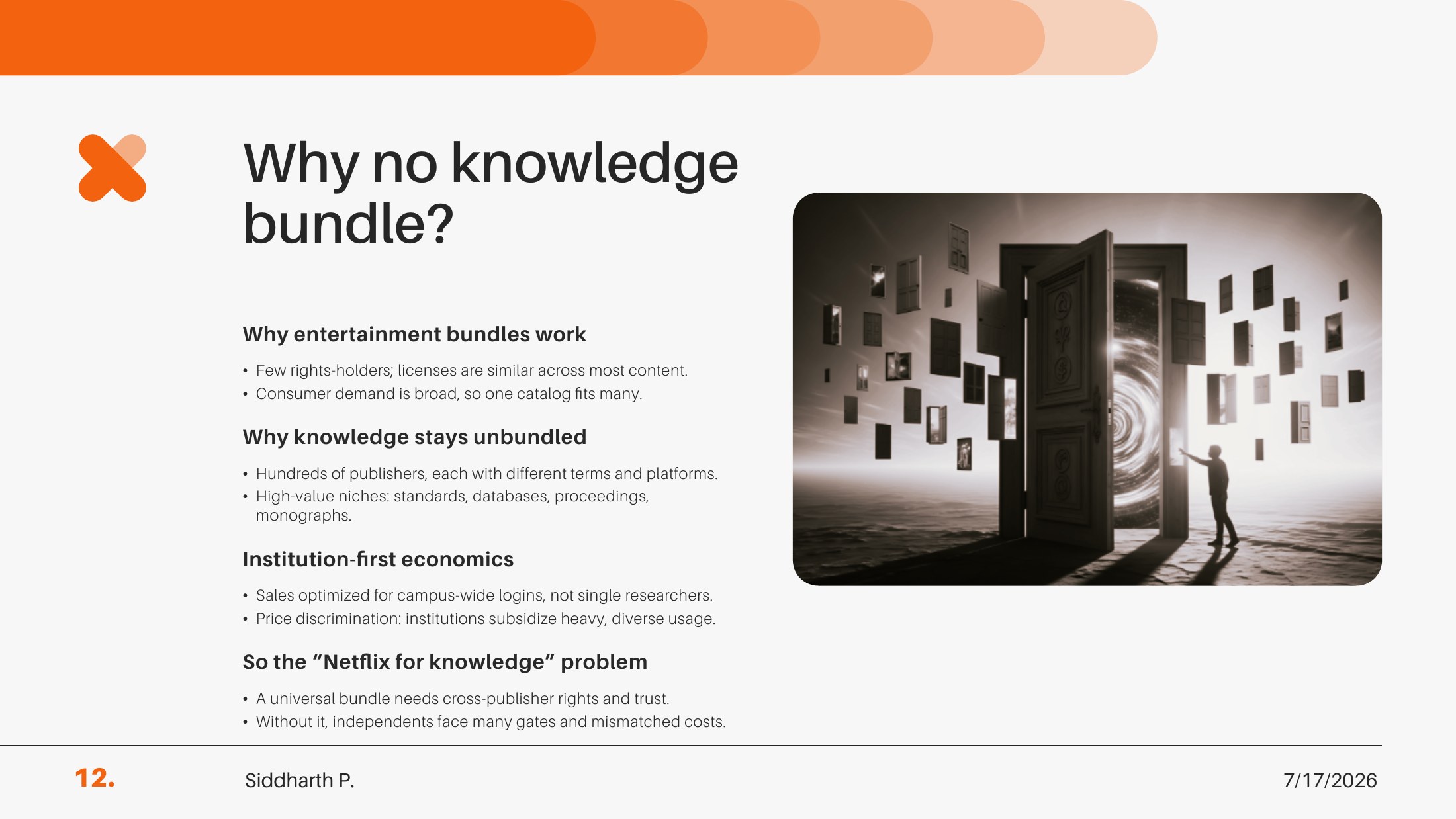
The short answer is that “professional knowledge” is not one catalogue controlled by one rights system.
Journal articles, books, standards and databases are produced and licensed through different markets. Publishers may control the version of record, while authors or institutions retain rights to other versions. Libraries buy access for defined user populations. Standards bodies fund part of their work through publication sales. Specialist databases sell not only documents but indexing, classification and analysis. A subscription that combined all of these would have to reconcile many rights holders, formats, pricing models and restrictions.
That explains why a universal bundle is difficult. It does not make the present system adequate.
The absence of one perfect subscription leaves individuals assembling their own improvised access stack: one public library membership, one professional association, several open repositories, occasional purchases and requests sent directly to authors. It can work. It is neither seamless nor dependable.
Research, books, standards and databases sit inside different rights and licensing systems.
Open access has changed the landscape, but not completed it
The situation is better than it first appears when a publisher page presents a payment screen.
Unpaywall searches for legally available open versions of articles associated with a DOI. Open Access Button can locate an accessible version or help request one from the author. CORE aggregates papers from repositories, preprint servers and open-access journals. OpenAlex provides an open catalogue of scholarly works and links records to available open-access copies. The Directory of Open Access Journals indexes open-access journals and articles across disciplines and countries.
These services matter because a paywalled publisher page does not always mean the work itself is lawfully unavailable. An accepted manuscript may exist in an institutional repository. A preprint may provide the substance of the research. The author may be permitted to share a version directly.
But open-access discovery remains a safety net, not a full replacement for institutional access.
Coverage varies by discipline and publication. The accessible version may differ from the final version of record. Books are less consistently available. Some datasets and supplementary materials remain separate. Citation databases and specialist research tools may still require subscriptions. Finding a paper is also not the same as having the wider collection needed to follow its references.
Open access has created important routes through the wall. It has not removed the wall everywhere.
Standards reveal the gap most clearly
Technical standards make the problem sharper because the user may need a precise edition, not a general explanation of the subject.
ISO’s Online Browsing Platform allows people to search standards and preview selected sections, including scope, references and definitions. ISO is explicit, however, that the preview is partial and cannot substitute for the official publication. Full standards are generally obtained through ISO or a national standards body.
That arrangement may be manageable for an organization with a standards budget. It is more difficult for an independent professional who needs to consult several documents merely to determine which one is relevant.
This is not an argument that every standard must be distributed without cost. Standards require development, coordination, maintenance and publication. It is an argument that access models should recognize legitimate individual use: discovery access, affordable read-only plans, short-term consultation, library partnerships and carefully defined professional subscriptions.
A person should not have to purchase a collection blindly in order to discover which document contains the necessary requirement.
The existing alternatives form a route, not a system
An independent researcher can still work legally and rigorously, but the process requires more deliberate navigation.
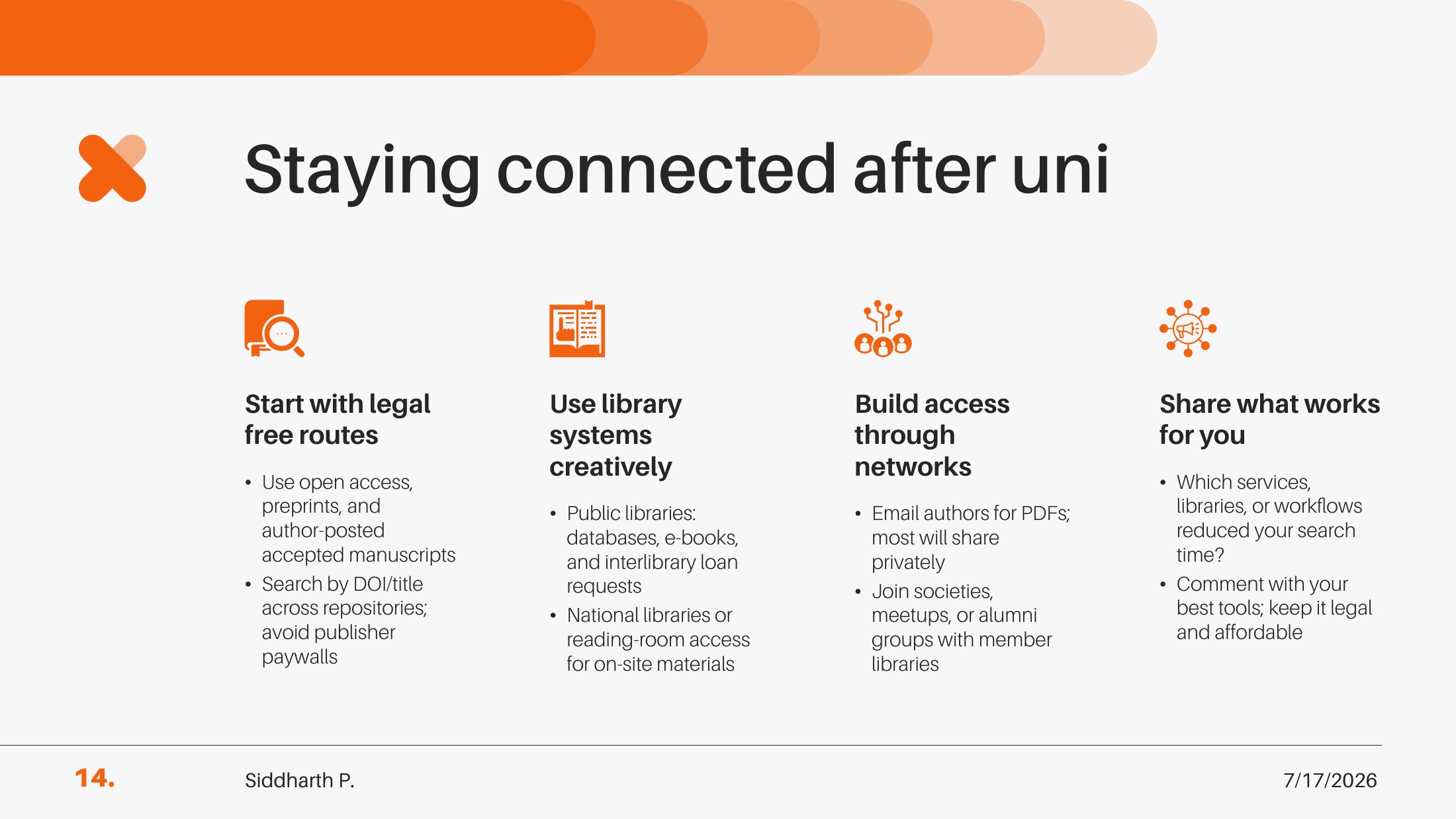
Start with the identifier. Search the title or DOI through an open-access discovery service rather than assuming the publisher page is the only copy.
Search repositories. Universities often preserve author manuscripts even when publisher versions remain restricted. Subject repositories and preprint servers can provide legitimate access to developing and accepted work.
Use libraries creatively. Public, national and specialist libraries may provide databases, interlibrary loans, reading-room access or document delivery. The exact offer varies, so a conversation with a librarian is often more useful than browsing a membership page.
Check alumni and professional networks. Some universities offer limited alumni access, and some professional associations include publications or standards within membership. These arrangements should be verified rather than assumed; licensing agreements frequently restrict remote access.
Ask the author. A concise request for a shareable manuscript is lawful, ordinary and often successful. Researchers generally want their work to be read.
Purchase selectively. When a standard or specialist work is genuinely required for professional use, identify the correct edition and scope before buying it. Preview pages, catalogues and library records can reduce expensive mistakes.
Finally, preserve the route you found. Record identifiers, licences, repository links and edition information. Independent research becomes more sustainable when access knowledge is treated as part of the research record rather than rediscovered each time.
Open sources, libraries, professional networks and direct sharing form a route—but not yet a coherent system.
Access should follow the person
The deeper issue is not whether a determined individual can eventually locate one paper. Usually, with enough patience, someone can.
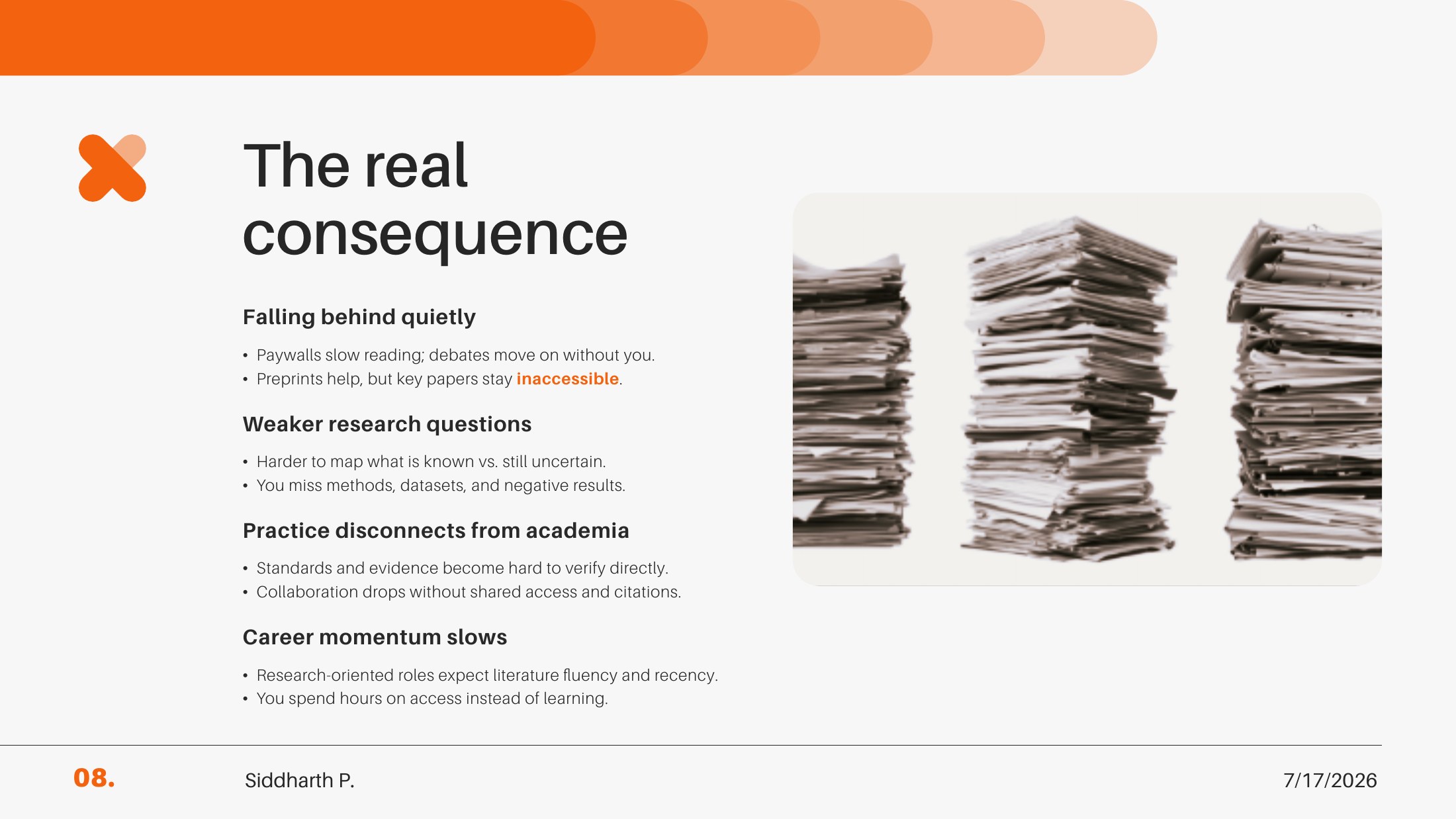
The issue is what repeated friction does to inquiry.
It discourages following references that may prove unhelpful. It pushes people toward whatever is easiest to access rather than what is most authoritative. It makes interdisciplinary work harder because every new field brings a new set of platforms and conventions. It slows professionals who are already working without the research support available inside a university or large company.
Most importantly, it confuses institutional membership with intellectual legitimacy.
A more durable system would make access portable. Researchers could retain a persistent identity independent of employment or university status. Libraries could offer clearly scoped memberships for unaffiliated professionals. Publishers and standards bodies could provide individual discovery and reading plans designed for serious but non-institutional use. Public funding could support shared access infrastructure where the social value of informed practice exceeds the value of another isolated subscription.
None of this requires pretending that knowledge is free to produce. It requires recognizing that the people who need knowledge do not remain inside the same institution throughout their lives.
My university login expired exactly when it was supposed to. The surprising part was how much of the scholarly world seemed to expire with it.
Graduation should mark the end of a course of study. It should not mark the end of practical access to knowledge.
Useful legal access routes
- Unpaywall — finds open-access locations for research associated with a DOI.
- Open Access Button — searches for legal copies and can facilitate author requests.
- CORE — aggregates open-access research from repositories and journals.
- OpenAlex — open scholarly catalogue with links to available open versions.
- Directory of Open Access Journals — index of open-access journals and articles.
- ORCID — a persistent researcher identity that does not require institutional affiliation.
- ISO Online Browsing Platform — discovery and partial preview of ISO standards; not a substitute for an official copy.
This article discusses lawful access routes. Availability, licensing and library privileges vary by publication, institution, country and user category.